The California RCFE Startup Kit
A plain-English guide to opening a six-bed care home in California.
I'm Jas Singh. I help care home owners buy and sell facilities, and first-time buyers keep asking me the same questions: which license, which house, how much cash. So my team and I wrote the answers down in one place, with the code section or CDSS form cited next to the key rules so you can check us.
What can a home make? Filled and well run, a six-bed home with private rooms nets anywhere from about break-even (or a small loss) in a cautious case to $10,700–$16,400 a month in a strong one. It depends heavily on where the house is.*
14-day money-back guarantee.
*Hypothetical 2026 estimates for a filled home, before owner pay and income taxes. Not a guarantee or typical result. See the regional math, assumptions, and earnings disclaimer.
- Course
- 17 lessons in 5 modules plus a toolkit
- Guide
- 29 pages, PDF, printable
- Workbook
- 9 tabs, Excel or Google Sheets
- Worksheets
- 3, printable
- Price
- $97, once
- Refund
- 14 days, in full
Why six beds, and not seven
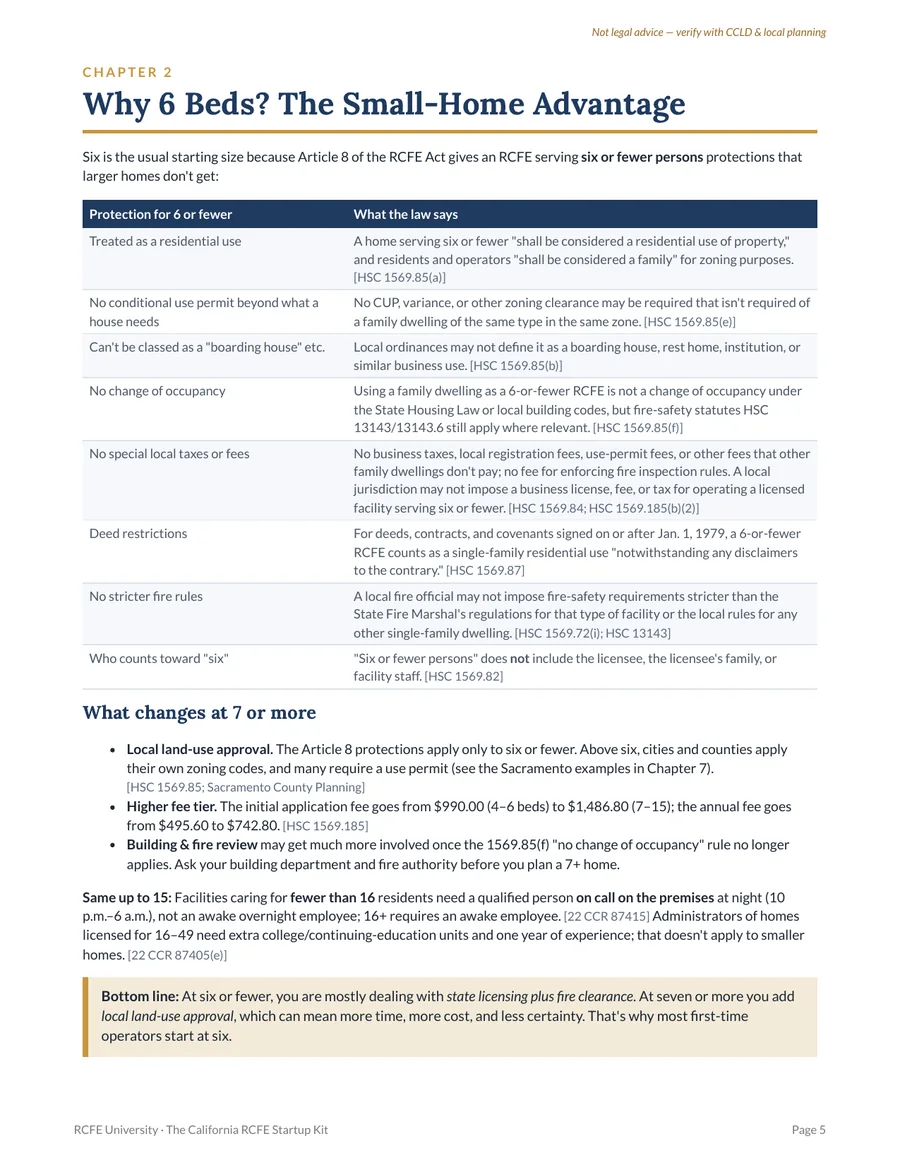
Under Article 8 of the RCFE Act, a licensed home serving six or fewer residents is treated much like any other house on the street. Go to seven and it becomes a different kind of project. Here is what staying at six gets you.
| Protection at 6 or fewer | What it means for you |
|---|---|
| Treated as a residential use | The home "shall be considered a residential use of property," and residents and operators are considered a family for zoning purposes. [HSC 1569.85(a)] |
| No conditional use permit | No CUP, variance, or zoning clearance beyond what a family dwelling in the same zone needs. [HSC 1569.85(e)] |
| No change of occupancy | Using a family dwelling as a 6-or-fewer RCFE isn't a change of occupancy under the State Housing Law or local building codes (fire-safety statutes still apply). [HSC 1569.85(f)] |
| No special local business taxes or fees | A local jurisdiction may not impose a business license, fee, or tax for operating a licensed facility serving six or fewer. [HSC 1569.84; 1569.185(b)(2)] |
| Staff and your family don't count | "Six or fewer persons" doesn't include the licensee, the licensee's family, or staff. [HSC 1569.82] |
What a six-bed home can earn, by region
People ask me this first. The honest answer is that it depends on where the house is, so here are three kinds of California markets. The house is the same in each: six private rooms, one caregiver awake and on duty around the clock, and a second caregiver four hours a day at peak. Wages, rents, and fees are 2026 numbers. Each market has a cautious case, a middle case, and a strong case for a well-run home.
| Per month | Tier ALower-cost metrosFresno, Bakersfield, Stockton, Modesto, Visalia, Redding | Tier BMid-cost metrosSacramento region, Inland Empire (Riverside / San Bernardino) | Tier CHigh-cost coastal metrosLos Angeles, Orange County, San Diego, Bay Area |
|---|---|---|---|
| Private-room rate | $5,500–$6,500/mo | $6,500–$7,500/mo | $7,500–$8,500/mo |
| Revenue 5–5.75 of 6 rooms filled | $27,500–$37,400 | $32,500–$43,100 | $37,500–$48,900 |
| Caregiver staffing 196 h/wk at the wage shown, + 18% | $18,000at $18.00/h | $19,500at $19.50/h | $21,500at $21.50/h |
| House lease | $3,200–$4,000 | $4,500–$5,500 | $5,500–$8,500 |
| Food, utilities, insurance, supplies, admin | $5,400–$7,100 | $5,400–$7,100 | $5,400–$7,100 |
| Total expenses | $26,600–$29,200 | $29,400–$32,200 | $32,400–$37,200 |
| Net per month | |||
| Conservative | −$1,700 | $300 | $300 |
| Mid | $5,100 | $7,700 | $9,200 |
| Strong | $10,700 | $13,700 | $16,400 |
Tier A: Lower-cost metros
Fresno, Bakersfield, Stockton, Modesto, Visalia, Redding
- Private-room rate
- $5,500–$6,500/mo
- Revenue5–5.75 of 6 rooms filled
- $27,500–$37,400
- Caregiver staffing196 h/wk at $18.00/h + 18%
- $18,000
- House lease
- $3,200–$4,000
- Food, utilities, insurance, supplies, admin
- $5,400–$7,100
- Total expenses
- $26,600–$29,200
Net per month
Tier B: Mid-cost metros
Sacramento region, Inland Empire (Riverside / San Bernardino)
- Private-room rate
- $6,500–$7,500/mo
- Revenue5–5.75 of 6 rooms filled
- $32,500–$43,100
- Caregiver staffing196 h/wk at $19.50/h + 18%
- $19,500
- House lease
- $4,500–$5,500
- Food, utilities, insurance, supplies, admin
- $5,400–$7,100
- Total expenses
- $29,400–$32,200
Net per month
Tier C: High-cost coastal metros
Los Angeles, Orange County, San Diego, Bay Area
- Private-room rate
- $7,500–$8,500/mo
- Revenue5–5.75 of 6 rooms filled
- $37,500–$48,900
- Caregiver staffing196 h/wk at $21.50/h + 18%
- $21,500
- House lease
- $5,500–$8,500
- Food, utilities, insurance, supplies, admin
- $5,400–$7,100
- Total expenses
- $32,400–$37,200
Net per month
How to read this. Conservative = low end of local rates, 5 of 6 rooms filled, high-end costs. Mid = middle rates, 5.5 filled. Strong = top-of-market rates for a new or well-finished home, 5.75 filled (96%), lean costs. All figures are for a home that has already filled up. If you cover 40 caregiver hours a week yourself, add about $3,700–$4,400/month.
Before profit comes the fill-up. In the kit's detailed Year-1 example, the cumulative cash low point during fill-up is about $103,771. Plan for the ramp, not just the stabilized month.
Every assumption and line item, all 3 tiers × 3 cases
Tier A: Lower-cost metros
| Monthly | Conservative | Mid | Strong |
|---|---|---|---|
| Private-room rate | $5,500 | $6,000 | $6,500 |
| Residents (of 6) | 5 | 5.5 | 5.75 |
| Revenue | $27,500 | $33,000 | $37,375 |
| Caregiver staffing | $18,040 | $18,040 | $18,040 |
| House lease | $4,000 | $3,600 | $3,200 |
| Food | $2,125 | $2,200 | $2,156 |
| Utilities | $1,350 | $1,100 | $900 |
| Insurance | $1,000 | $800 | $600 |
| License fee | $41 | $41 | $41 |
| Supplies | $600 | $500 | $400 |
| Maintenance | $500 | $400 | $300 |
| Admin, software, accounting, marketing, training, reserve | $1,500 | $1,250 | $1,000 |
| Total expenses | $29,156 | $27,931 | $26,637 |
| Net (before owner pay) | −$1,656 | $5,069 | $10,738 |
Tier B: Mid-cost metros
| Monthly | Conservative | Mid | Strong |
|---|---|---|---|
| Private-room rate | $6,500 | $7,000 | $7,500 |
| Residents (of 6) | 5 | 5.5 | 5.75 |
| Revenue | $32,500 | $38,500 | $43,125 |
| Caregiver staffing | $19,543 | $19,543 | $19,543 |
| House lease | $5,500 | $5,000 | $4,500 |
| Food | $2,125 | $2,200 | $2,156 |
| Utilities | $1,350 | $1,100 | $900 |
| Insurance | $1,000 | $800 | $600 |
| License fee | $41 | $41 | $41 |
| Supplies | $600 | $500 | $400 |
| Maintenance | $500 | $400 | $300 |
| Admin, software, accounting, marketing, training, reserve | $1,500 | $1,250 | $1,000 |
| Total expenses | $32,159 | $30,834 | $29,441 |
| Net (before owner pay) | $341 | $7,666 | $13,684 |
Tier C: High-cost coastal metros
| Monthly | Conservative | Mid | Strong |
|---|---|---|---|
| Private-room rate | $7,500 | $8,000 | $8,500 |
| Residents (of 6) | 5 | 5.5 | 5.75 |
| Revenue | $37,500 | $44,000 | $48,875 |
| Caregiver staffing | $21,548 | $21,548 | $21,548 |
| House lease | $8,500 | $7,000 | $5,500 |
| Food | $2,125 | $2,200 | $2,156 |
| Utilities | $1,350 | $1,100 | $900 |
| Insurance | $1,000 | $800 | $600 |
| License fee | $41 | $41 | $41 |
| Supplies | $600 | $500 | $400 |
| Maintenance | $500 | $400 | $300 |
| Admin, software, accounting, marketing, training, reserve | $1,500 | $1,250 | $1,000 |
| Total expenses | $37,164 | $34,839 | $32,445 |
| Net (before owner pay) | $336 | $9,161 | $16,430 |
Staffing: 196 paid hours/week = one caregiver on duty around the clock (168 h, three 8-hour shifts, no daily overtime) + a second caregiver 4 h/day. Higher-acuity residents may need more staff. Burden 18% = payroll taxes, workers' comp, paid sick leave, overtime cushion. Housing is a lease; if you buy, use your own mortgage, tax, and insurance payment.
Sources: private-room rates are operator-reported by Jas Singh for new or well-finished homes (lowest non-rural ≈ $5,500; mainstream $6,500–$8,000+), cross-checked against the Genworth/CareScout 2024 Cost of Care Survey (California assisted living / residential care median $7,350/mo, private one-bedroom). Published board-and-care averages run lower ($3,500–$7,000; e.g., Carehomefinders, BayAreaBoardAndCare.com) because they include shared rooms and older homes. Wages: CA minimum wage $16.90 (DIR, 2026); BLS OEWS home health & personal care aide means $16.16–$17.25/hr in CA metros (2024–2025); model wages are set above those (assumption) because RCFEs compete for caregivers. Payroll burden 18%: FICA 7.65%, CA UI/ETT and FUTA (EDD, Federal Register), workers' comp (WCIRB class 8829 pure premium $2.74 per $100 payroll, Sept 2025, plus carrier load), paid sick leave. Housing: HUD FY2026 Fair Market Rents (4-bedroom $2,393–$5,246 across these metros; 6-bedroom-equivalent = 4-BR × 1.30 per HUD), with upper ends above FMR for newer homes (assumption). Food: USDA Moderate/Liberal food plans, Aug 2026. Electricity: EIA, 33.61¢/kWh (July 2026). Annual license fee $495.60 (HSC 1569.185). Insurance, supplies, maintenance, admin, and occupancy are labeled assumptions.
Five things to know before you sign a lease
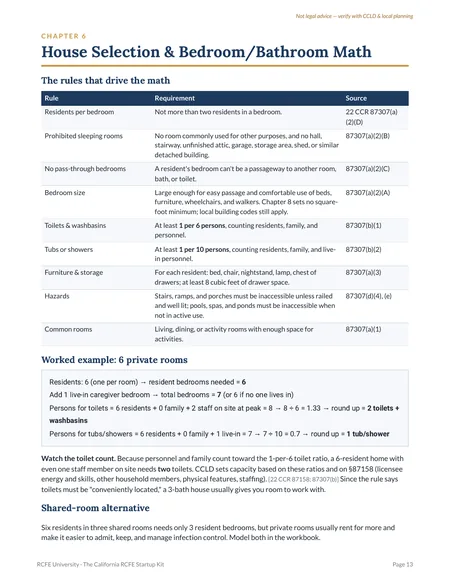
Staff count toward the toilets. Title 22 asks for one toilet and washbasin per six persons, and personnel and family count, not just residents. Six residents plus staff means at least two. [22 CCR 87307(b)(1)]
A walker changes the fire picture. Walkers and wheelchairs make a person nonambulatory under Title 22. A house cleared only for ambulatory residents limits who you can admit and keep as people age. Ask the fire authority for a pre-inspection before you buy or sign. [22 CCR 87101(n)(2); LIC 9092]
The administrator certificate is $140, after the course and the exam. First an 80-hour CDSS-approved course, then a 100-question state exam (70% to pass), then the application. Renewal is another $140 every two years. [HSC 1569.616]
That certificate queue is slow right now. In early October 2026 the state's administrator certification office was working on applications received the week of June 30, roughly 13 to 14 weeks behind. An administrator tied to a pending facility application gets expedited and approved with the license. [CDSS ACB processing dates]
Incomplete packets come back. CCLD's application bureau returns incomplete packets, and its stated expectation is 90–120 days for the application process. Submit when the house, the money, and the paperwork are actually ready. [CDSS CAB page; LIC 281]
Where the kit answers the usual questions
Which license do I need, and what does CCLD want in the application packet?
Lesson 2 and Lesson 5What an RCFE is; the licensing checklistWill this house pass? How many bathrooms do six residents plus staff need?
Lesson 7House selection and bedroom/bathroom math, plus Worksheet 1Everyone says start with six beds. Why six, exactly?
Lesson 3Free to read: sample lessonHow much cash do I really need before the beds fill up?
Lesson 9 and Lesson 10Startup budget; pro forma and Year-1 rampWhat's the realistic timeline from today to my first resident?
Lesson 4The launch roadmap and timeline
What's in the kit
Five modules and a toolkit. Read it online with your progress saved, or download the guide and the workbook and work offline. Here is the full table of contents.
Module 1Foundations
- 01Read This First
- 02What an RCFE Is (and Isn't)
- 03Why 6 Beds? The Small-Home Advantage
- 04The Launch Roadmap & Timeline
Module 2Licensing & Fire Clearance
- 05Licensing Checklist
- 06Fire Clearance, Nonambulatory & Hospice
Module 3The Property
- 07House Selection & Bedroom/Bathroom Math
- 08Zoning & Local Rules
Module 4The Numbers
- 09Startup Budget Template
- 106-Bed Private-Room Pro Forma (Example)
- 11Who Pays: Revenue Sources to Research
Module 5Operations & Launch
- 12Staffing Outline
- 13Operating Documents Before Day One
- 14Common Mistakes
- 15Sacramento & Northern California Notes
ToolkitWorksheets & Sources
- 16Printable Worksheets
- 17Official Sources
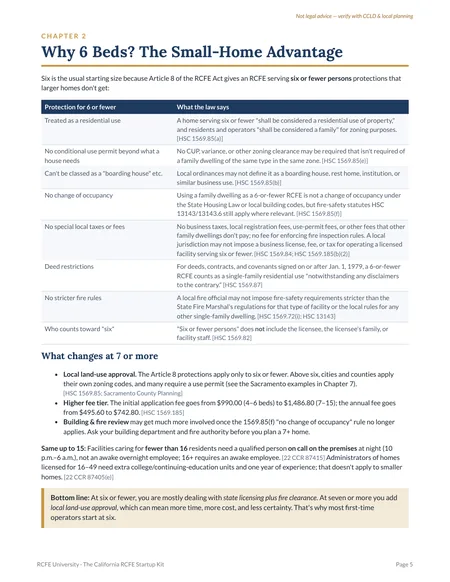
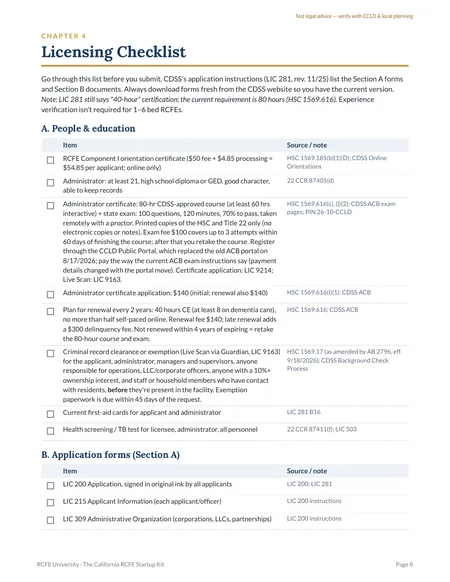
Licensing checklist. Orientation, the 80-hour administrator certification and exam, LIC 200/215/500/610E/999/9282, Plan of Operation, fees, and fire clearance, each with its source.
House-selection system. Title 22 ratios (max 2 residents per bedroom, 1 toilet per 6 persons, 1 tub/shower per 10), a worked 6-bed example, and a 1–5 property scorecard.
Editable workbook. Assumptions, Pro Forma, Year-1 Ramp, Startup Budget, House Evaluator, Staffing, CA Market Tiers, and Sources tabs. Opens in Excel, Google Sheets, or LibreOffice.
12 costly mistakes. Like forgetting staff count toward your toilet ratio, or assuming every senior is ambulatory, and how to avoid them.
The workbook, as it opens
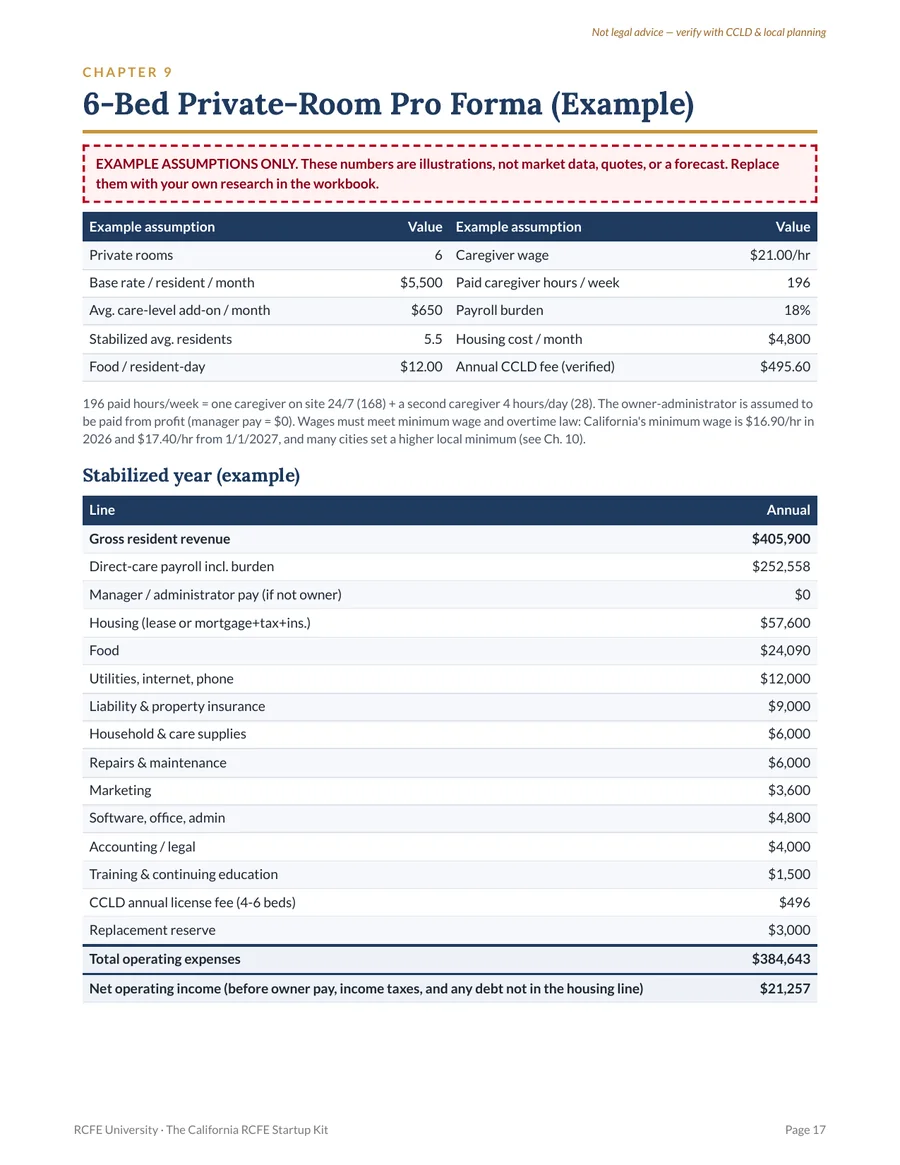
This is the Pro Forma tab with the kit's example assumptions filled in. The yellow cells are yours to replace with real quotes. In this example the home loses money at four and five residents and makes money at six, which is exactly why you run it before you sign anything.
Example assumptions only. Not market data and not a forecast.
| A | B | C | D | E | |
|---|---|---|---|---|---|
| 5 | Line item | Stabilized (annual) | 4 residents | 5 residents | 6 residents |
| 6 | Gross resident revenue | $405,900 | $295,200 | $369,000 | $442,800 |
| 7 | Operating expenses | ||||
| 8 | Direct-care payroll incl. burden | $252,558 | $252,558 | $252,558 | $252,558 |
| 9 | Manager / administrator pay | $0 | $0 | $0 | $0 |
| 10 | Housing | $57,600 | $57,600 | $57,600 | $57,600 |
| 11 | Food | $24,090 | $17,520 | $21,900 | $26,280 |
| 12 | Utilities, internet, phone | $12,000 | $12,000 | $12,000 | $12,000 |
| 13 | Insurance | $9,000 | $9,000 | $9,000 | $9,000 |
| 14 | Supplies | $6,000 | $6,000 | $6,000 | $6,000 |
| 15 | Repairs & maintenance | $6,000 | $6,000 | $6,000 | $6,000 |
| 16 | Marketing | $3,600 | $3,600 | $3,600 | $3,600 |
| 17 | Software, office, admin | $4,800 | $4,800 | $4,800 | $4,800 |
| 18 | Accounting / legal | $4,000 | $4,000 | $4,000 | $4,000 |
| 19 | Training & CE | $1,500 | $1,500 | $1,500 | $1,500 |
| 20 | CCLD annual license fee | $496 | $496 | $496 | $496 |
| 21 | Replacement reserve | $3,000 | $3,000 | $3,000 | $3,000 |
| 22 | Total operating expenses | $384,643 | $378,073 | $382,453 | $386,833 |
| 23 | Net operating income (before owner pay, debt beyond housing line, taxes) | $21,257 | ($82,873) | ($13,453) | $55,967 |
| 24 | NOI margin | 5.2% | -28.1% | -3.6% | 12.6% |
| 25 | Break-even residents (approx.) | 5.2 |
Who I wrote it for
- Caregivers, CNAs, nurses, and other healthcare workers ready to open their own home.
- Real estate investors looking at a house for RCFE use.
- Families thinking about turning a property into a six-bed board-and-care.
- Anyone in California who wants a clear, cited starting point before paying for courses, contractors, or a property.
Who should skip it
- Anyone looking for a get-rich-quick plan. Profit swings hard with occupancy and local costs, and the math on this page shows the break-even cases too.
- Anyone who wants to provide skilled nursing in a home setting. An RCFE gives non-medical care.
- Anyone hoping to skip the CDSS orientation and the administrator course. You still need both.
The price
No subscription and no recurring charges.
- Course17 lessons in 5 modules plus a toolkit, with progress tracking
- Guide29-page PDF to print and mark up
- WorkbookEditable 9-tab Excel file: pro forma, Year-1 ramp, startup budget, house evaluator, staffing, CA market tiers
- ChecklistLicensing checklist with each form and requirement tied to its source
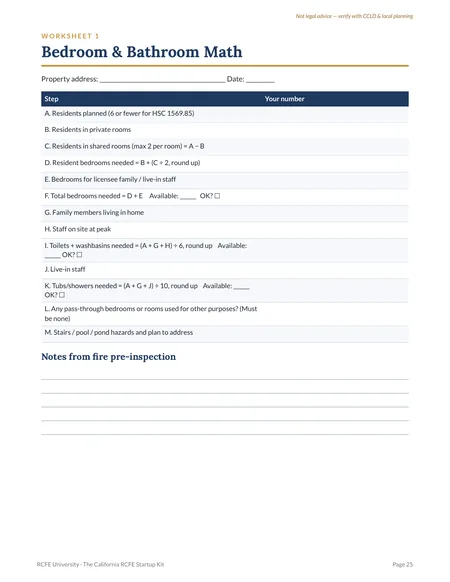
- WorksheetsBedroom and bathroom math, property scorecard, 120-day application tracker
- BonusThe free California RCFE Licensing Checklist PDF
- AccessInstant, right after checkout. Download the files and keep them.
14-day money-back guarantee. If the kit isn't useful to you, email hello@rcfeuniversity.com within 14 days of purchase for a full refund.
Questions
What exactly do I get?
The online course (17 lessons in 5 modules plus a toolkit), the 29-page PDF guide, the editable 9-tab Excel workbook (Assumptions, Pro Forma, Year-1 Ramp, Startup Budget, House Evaluator, Staffing, CA Market Tiers, and more), three printable worksheets, and the free licensing checklist. Download the files and keep them.
How do I get access after I pay?
Checkout sends you straight into the course, and your browser stays signed in. You'll also see a private access link to bookmark. If you lose access, use Restore access or email me at hello@rcfeuniversity.com.
What if it isn't right for me?
There's a 14-day money-back guarantee. If the kit isn't useful to you, email hello@rcfeuniversity.com within 14 days of purchase for a full refund. The details are in the refund policy.
Is this legal advice?
No. It's an educational summary of official sources as read in October 2026. Rules, forms, and fees change. Verify everything with CDSS Community Care Licensing (CCLD), your local planning and building departments, and your fire authority, and hire an attorney, CPA, and insurance professional where you need one.
Does it replace the CCLD orientation or the 80-hour administrator course?
No. California requires an RCFE orientation and, for administrators, a CDSS-approved 80-hour certification program plus a state exam (Health & Safety Code §1569.616). The kit helps you plan around those steps and everything else: the house, the packet, the numbers. It doesn't replace them.
Does it only apply to Sacramento?
No. The state licensing rules and the six-or-fewer zoning protection apply statewide. The local examples come from Sacramento and Northern California, and the kit gives you the exact questions to ask your own city or county.
Will I make money with a 6-bed home?
I can't promise that, and the kit doesn't. The regional estimates show a filled, well-run 6-bed private-room home netting roughly break-even in a cautious case, about $5,000–$9,000/month in a mid case, and $10,000–$16,000+/month in a strong case, depending on where it is (before owner pay and income taxes). Those are hypothetical estimates, not typical results. Occupancy, local rates, and staffing decide the outcome, and most homes lose money while they fill. The workbook lets you plug in your own numbers.
What software do I need?
Any web browser for the course, a PDF reader, and a spreadsheet program: Microsoft Excel, Google Sheets, or LibreOffice.
Is checkout secure?
Yes. Stripe handles payment on its own hosted checkout. Card details never touch this website.
I have a question before buying.
Email us at hello@rcfeuniversity.com.
If you're serious about a six-bed home, start with the rules and the numbers.
That's what this kit covers. It won't open the home for you. It's meant to help you avoid leasing the wrong house or running out of cash during the fill-up.